Tax Justice Capacity Building for Civil Society
03 December 2025
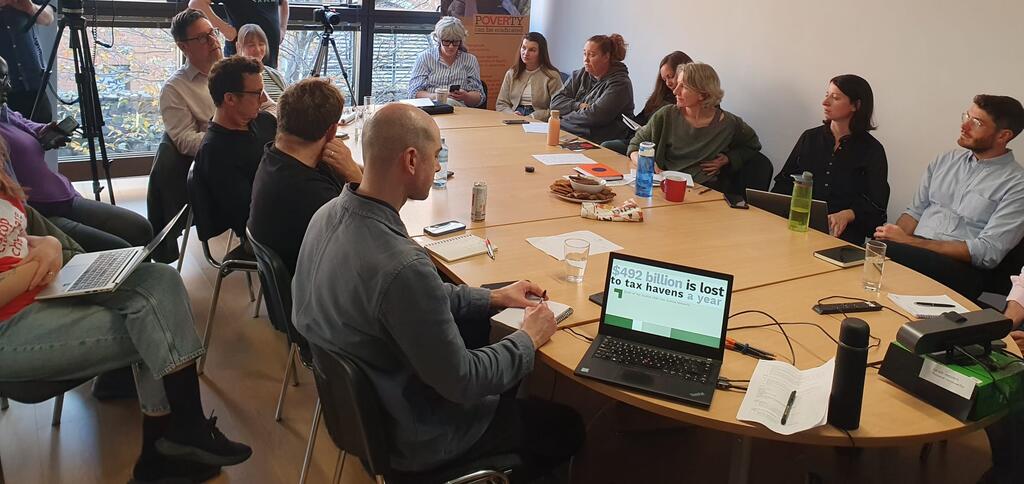
In late October, Financial Justice Ireland organised a tax justice capacity-building event for civil society in Dublin. The event was hosted in collaboration with Oxfam Ireland, Christian Aid Ireland and ActionAid Ireland and included both national and international speakers.
The participants attending the event included staff from global justice NGOs, educators, activists, and representatives from various civil society organisations, such as local development companies, housing and climate community groups.
We were delighted to be joined by Alex Cobham, economist and Chief Executive of the Tax Justice Network - a leading international research and advocacy organisation with a mission to ‘work every day, to inspire and equip people and governments everywhere to reprogramme their tax systems to work for everyone’. Alex gave us a panoramic view of the current debates and struggles, sharing his analysis as to where strategic advocacy can have an impact in the current context.
’The numbers we have in cross border tax abuse by multinational corporation and wealthy individuals hiding their assets in income streams offshore give you something like half a trillion dollars in lost revenues every year … if you had national wealth taxes everywhere, of the type Spain has in place now for example, you’re looking at another two trillion dollars. What that gives you in one year alone, if you fix it, is enough to get you started on climate reparations while every country would have significant resources leftover to invest domestically, there is a win-win option here’’ - Alex Cobham, Tax Justice Network
Also joining us to present her research was Dr. Nessa Ní Chasaide, of Maynooth University. Nessa provided a clear guide to Ireland’s corporate tax model by drawing on both her PhD research and her years of experience working for Financial Justice Ireland. Nessa articulated the specifics of Irish tax ‘games’, with particular focus on the state’s relationship to foreign direct investment, the rerouting of profits, and the onshoring of intellectual property.
“It is always a pleasure working with FJI and colleagues as they seek to demystify global taxation and to highlight Ireland’s problematic role. Global tax is a technical area, but ultimately, it is about how the profits of multi-national companies can be distributed and taxed more fairly for the common good. Global justice NGOs in Ireland like FJI, Christian Aid, Oxfam and AFRI lead the way in highlighting this massive ethical problem and actions that can be taken to address it.” Dr. Nessa Ní Chasaide, Maynooth University
Finally, we greatly appreciated being joined by Ucizi Ngulube, Project Coordinator for ActionAid Zambia / TaxEd Alliance, who highlighted some of these issues, such as how servicing exorbitant legacy debts to the Global North heavily suppresses social spending.
“Presenting the Zambian perspective to colleagues in Ireland was both timely and symbolic. As conversations on global tax reform grow louder, highlighting how illicit financial flows and unfair tax incentives affect countries like ours felt especially relevant given Ireland’s influential role in global financial policy. It reminded us why international solidarity is essential to achieving true tax justice.” Ucizi Ngulube, ActionAid Zambia
One thing that was clear from all speakers was that the terrain is shifting; tolerance of tax abuse is waning, as is the willingness to turn a blind eye to its role in worsening inequality, growing authoritarianism, and climate breakdown. Negotiations now underway at the UN on a framework convention for international tax cooperation provide a crucial forum where all countries, including Global South countries historically marginalised from negotiations, have a say in setting the rules on tax cooperation for the future. Discussions in Ireland remain focused on the need to reduce dependency for windfall corporation taxes from a small number of companies; but also urgent and necessary in the debate is the impact of Ireland’s model internationally, and the role we have been playing and continue to play in multilateral negotiations.